
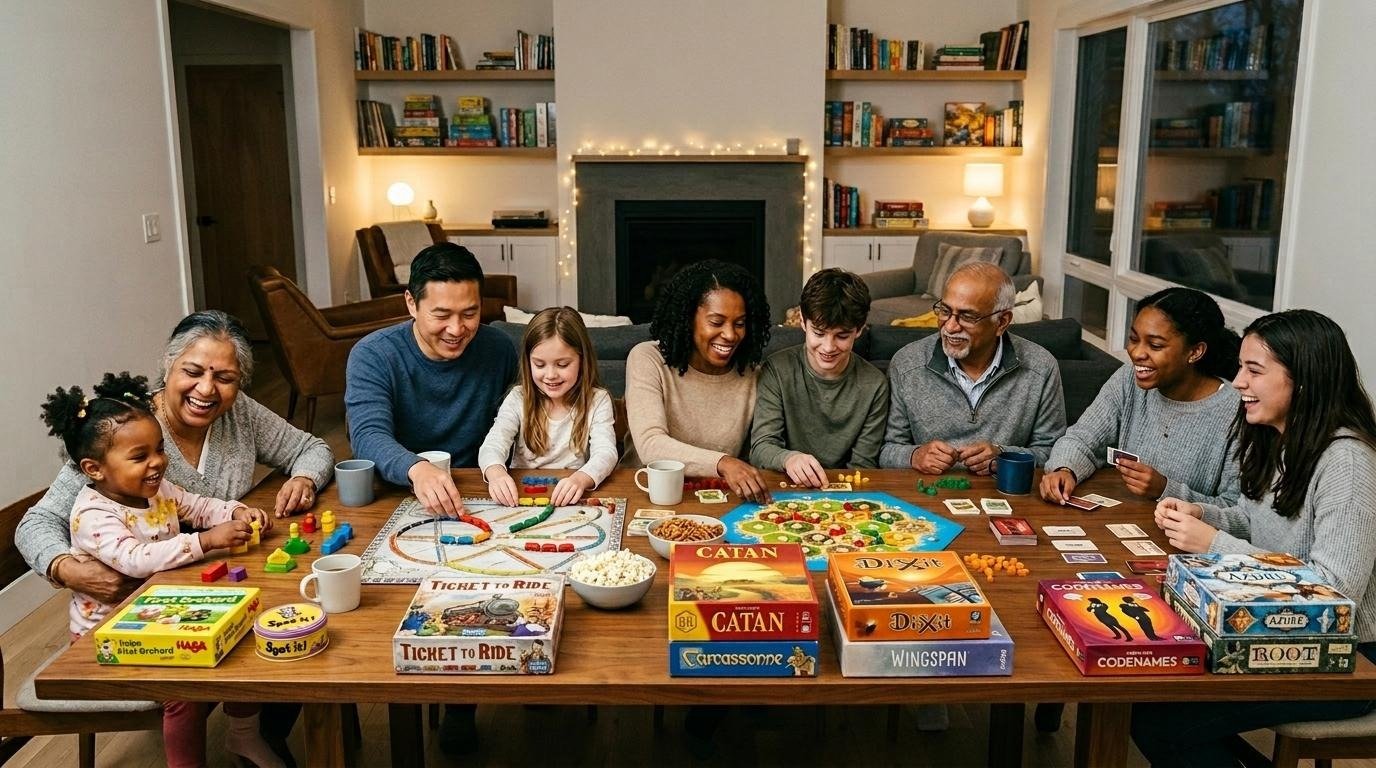
Education, sports, and extracurricular activities fundamentally impact a child’s cognitive and emotional growth, encouraging overall growth and facilitating the development of leadership skills in their future endeavours.
Nowadays, engaging kids in offline activities is tough because of social media and doomscrolling throughout the day. Social media apps and online games are flooding market spaces, stopping kids and parents from engaging in real-life activities and promoting better mental and physical health.
Let us see how board games are paving the way, and as a parent, how you can engage in real activities alongside your children.
What to Consider When Buying Board Games for Kids?
When buying board games for kids, prioritize age appropriateness, playtime, and mechanics. Here are more details:
- Age and Developmental Stage
While age recommendations are a great starting point, they are mainly guidelines. A highly experienced six-year-old may comfortably play games meant for eight-year-olds, while a preschooler may need games with no reading required.
For toddlers and preschoolers, look for games emphasizing color matching, simple counting, and turn-taking. For early elementary, focus on games with easy-to-learn strategies that test decision-making and deductive skills.
- Gameplay Mechanics
The way a game functions dictates how much fun kids will have. Competitive games can sometimes lead to meltdowns for younger kids. Avoid games requiring young children to hold a large hand of cards. They often end up showing their cards or dropping them on the floor.
- Theme and Engagement
A game’s theme is the best way to keep children invested. Kids are significantly more likely to learn and enjoy games themed around animals, food, or their favorite characters rather than dry economic or military simulations.
- Component Safety and Durability
If purchasing games for a household with toddlers, carefully review the box for small parts warnings. Sturdy, thick cardboard tiles and durable plastic pieces are essential for withstanding rough handling.
Now, the games that will help engage children and also give you some time together.
Parents’ Guide to Board Games
Here are the games suitable for the age groups and number of players mentioned:
- Codenames: Disney Edition
Number of Players: 2 to 8
Age Recommendation: 7 and above
It is a fantastic game for kids because it features iconic Disney characters, offers flexible rules to accommodate different ages, and seamlessly builds vocabulary and deduction skills.
The cards feature iconic images (like characters or movie objects) on one side and the corresponding words on the other. This is ideal for pre-readers or struggling readers who can play just as effectively using the visual clues.
It is entirely cooperative within teams. Kids learn communication, pattern recognition, and “theory of mind” as they try to interpret their clue-giver’s hints.
- Jenga
Number of Players: 1 or more
Age Recommendation: 6 and above
It effortlessly blends fun with vital developmental skills. By requiring players to carefully remove and stack wooden blocks, the game actively builds fine motor control, hand-eye coordination, and strategic thinking.
ids learn to gauge distance and space, and their brains quickly register how careful physical movements translate to the stability of the tower. Because it is a turn-based game, it naturally teaches patience, sharing, and good sportsmanship, whether playing with friends or family.
- Hasbro Gaming Scrabble
Number of Players: 2 to 4
Age Recommendation: 8 and above
It is a proven brain workout that naturally boosts vocabulary, spelling, and cognitive development while keeping kids entertained. For younger children, Scrabble Junior provides a gentler, more accessible learning curve.
Placing letters to form words reinforces phonics, introduces new vocabulary, and tests spelling. Kids constantly add and multiply their scores, building mental math and strategic thinking.
- Pictionary Air
Number of Players: 2 teams
Age Recommendation: 8 and above
It blends high-tech engagement with active, screen-free physical movement. By letting children draw in the air and see their sketches come to life on a smart device or TV, it builds creative problem-solving, quick-thinking, and teamwork in a hilarious, family-friendly way.
Unlike traditional board games, where kids sit hunched over a table, Pictionary Air gets them up and moving. Because the drawings are captured in mid-air, they involve the whole body, adding a kinesthetic and highly energetic element to playtime.
- Ticket to Ride
Number of Players: 2 teams
Age Recommendation: 8 and above
It is widely considered one of the best board games in the world because of its perfect balance of elegant simplicity and engaging strategy. It is easy enough for beginners to learn in minutes, but it offers deep, tactical decisions.
If you are ready to spend some quality time with your family, friends, or children, then look for board games for families.